

(Full time) 2024 start
Exploration Geophysics MSc
Overview
Earth’s resources are essential for our energy future – resources like water, minerals, hydrocarbon reserves or geothermal heat, as well as natural ‘geoassets’ in which CO2 or hydrogen could be stored. Exploration geophysicists play a critical role in sourcing natural resources — and understand the full resource potential of the subsurface.
That’s why the demand will always be high in this area, with organisations worldwide seeking more sustainable solutions that exploration geophysicists could provide.
Our Exploration Geophysics MSc degree will train you in utilising physical techniques and a range of disciplines to study the Earth’s interior, including seismic, gravity, magnetic and geo-electrical methods, applied throughout marine and onshore settings.
Established for over 50 years, our Exploration Geophysics MSc here at Leeds has strong links with industrial partners, global research institutes and the new Leeds Geosolutions Centre, each combining to support the application of geoscience expertise in the latest innovations in industry.
Our industry-relevant modules will equip you with the theoretical understanding and specialist skill set you’ll need to pursue a career in this exciting profession.
Why study at Leeds:
- This Masters degree is accredited by The Geological Society of London.
- Our active and globally-renowned research conducted right here on campus feeds directly into the course, shaping your learning with the latest thinking in the most pressing challenges in geoscience.
- Advance your knowledge and skills in key areas like seismic monitoring, near-surface geophysics, petrophysics, potential field techniques and geological processes.
- Conduct an individual research project that focuses on a genuine research challenge tailored to suit your interests and, often, in close collaboration with external partners, with the potential to undertake a subsidised internship.
- Access specialist facilities including geophysical survey equipment, industry-standard software packages and a dedicated computer cluster.
- Build a network of professional contacts through our weekly seminars from geoscience practitioners, from a range of international industries and research institutes.
- Experience expert practical and theoretical teaching, delivered by a programme team made up of geoscientists from the School’s Institute of Applied Geoscience and Institute of Geophysics and Tectonics.
Accreditation
Accreditation is the assurance that a university course meets the quality standards established by the profession for which it prepares its students.
The quality and relevance of our teaching has been recognised by an independent body of academics and industrialists through our Geological Society of London Professional Accreditation.
If you have an appropriate degree, our Geological Society accreditation will reduce the amount of experience required for you to reach Chartered Geologist (CGeol) status, an important career step in Geoscience.
Course content
The Exploration Geophysics curriculum is divided into three semesters, featuring eight taught modules and an independent research project. Taught modules cover a broad range of geophysical disciplines as applied to resource, environmental and engineering industries.
In semester 1, you'll learn the theoretical tools of the trade via fundamental modules, covering topics such as seismic fundamentals and acquisition, computational inverse theory, field and structural geology, seismic data processing and near-surface geophysics.
Throughout semester 2, you'll put this theory into practice with applied modules in topics such as reservoir geophysics, petrophysics, seismic interpretation, and gravity and magnetic methods. The semester culminates in a residential field trip, in which you'll undertake data acquisition and analyse the data you collect.
Project work
Throughout semester 3, over summer, you'll apply the skills learnt during the taught course to undertake an independent project to explore a current geophysics research problem. These projects are typically tailored to the individual interests of students and often involve an external collaborator – whether from the industrial or research sectors – with the potential to undertake an internship for at least part of the project period.
Project topics regularly include investigations of specific geological issues and prospects, studies of novel seismic analysis tools, and integrated geophysical investigations – on scales from basins to quarries. All are unique to each year, with a desired commercial or academic outcome. About 10% of projects involve fieldwork and can be case studies or innovative research-aligned investigations – even to a publishable standard.
Fieldwork

Exploration Geophysics features two field exercises. In semester 1, you'll undertake two days of field geology, to help you visualise subsurface targets and the geological structures that they represent. In semester 2, you'll complete a four-day residential field trip at a site in North Wales, where you'll use our geophysical survey systems to image and understand a variety of subsurface targets.
Course structure
The list shown below represents typical modules/components studied and may change from time to time. Read more in our terms and conditions.
Modules
Year 1
Compulsory modules
- Exploration Geophysics: Project and Dissertation 60 credits
- Computational Inverse Theory 15 credits
- Geophysical Reservoir Evaluation 15 credits
- Near-Surface Geophysics 15 credits
- Gravity and Magnetic Methods 15 credits
- Geological and Physical Methods for Subsurface Characterisation 15 credits
- Seismic Fundamentals and Acquisition 15 credits
- Seismic Data Processing 15 credits
- Seismic Reflection Interpretation and Sequence Stratigraphy 15 credits
Learning and teaching
Exploration Geophysics features a 22-week taught syllabus, spanning two semesters. You may expect an average of 25 hours of contact time from staff each week, via either face-to-face lectures, workstation practicals, or online workshops. A number of workshops are led by industry professionals, including topics on seismic processing, interpretation and inversion. You'll undertake coursework submissions throughout the taught course and have opportunities for constructive feedback on your work. Discussion of your progress and understanding among your MSc peers is encouraged.
You'll be assigned a personal tutor, who will maintain contact with you throughout the year and offer pastoral guidance. They will help you to settle into the University and clarify any procedures, as well as helping you prepare for employment upon graduation.
You’ll also learn the latest geophysical developments through our “Tuesday Talks” seminar series, featuring a weekly visit from a professional geophysicist. Our recent programme has featured professionals from Drax Power, Fugro, Shearwater, BP, Cornish Lithium and the British Antarctic Survey.
Active research environment
The Exploration Geophysics MSc curriculum is centred around research-based teaching, and you'll benefit from the active research programmes of the delivery team. Your research project will address a genuine geoscience issue and you'll be mentored in essential research skills by a project advisor. A selection of our staff’s current research projects can be seen in our School’s research pages.
Industry links
Strong links with industry reinforce this vocational Masters degree, helping you to develop a grounded perspective, as well as providing you with recruitment possibilities.
In addition to the industrial experience of many School staff and contributions from University of Leeds geoscience spin-out companies, you'll have numerous contacts with industry representatives throughout the year.
We have many visits from energy, geophysical acquisition, processing and software companies, primarily to engage with you and recruit Masters students throughout their degree. These visits include recruitment information, technical showcases and case studies of integrated geoscience in practice, as well as opportunities for you to network with geoscience professionals. Many offer 'guest lectures' on the taught course, to supplement what you'll learn from our defined syllabus and enhance strongly your employability.
Your summer project is typically carried out either with collaborating commercial companies or academic/government institutes. These projects are linked to current activities, representing actual problems for which a real research or business outcome is sought. Some are field based: some result in journal publications or conference presentations, such as at the EAGE conference. The projects finish with a presentation day, where you'll present your work to an audience of academic and industry visitors.
Specialist facilities
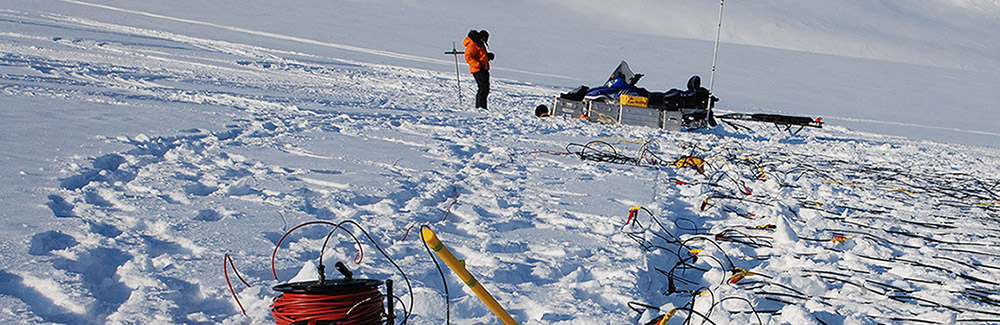
Our Exploration Geophysics course benefits from a dedicated computer cluster, where you'll receive training with numerous industry-standard software packages. These include MESA, Petrel™, Geosoft, RokDoc and Reveal™. Leeds maintains a sector-leading stock of geophysical survey systems, offering you the capacity to undertake your own data acquisitions using seismic, radar, magnetic, electrical and electromagnetic systems. This has recently been complemented with borehole tomography and distributed sensing technologies.
Programme team
The Programme Leader, Dr Adam Booth, is a specialist in near-surface geophysical surveying, with research interests throughout environmental and engineering geoscience settings. He is a Fellow of the Higher Education Academy and is committed to innovative and inclusive curriculum design.
The wider programme team is made up of geoscientists from the School’s Institute of Applied Geoscience and Institute of Geophysics and Tectonics, featuring specialists in data processing, computational geophysics, structural geology and resource exploration.
On this course you’ll be taught by our expert academics, from lecturers through to professors. You may also be taught by industry professionals with years of experience, as well as trained postgraduate researchers, connecting you to some of the brightest minds on campus.
Assessment
Modules are assessed through a variety of exam papers and coursework exercises. Each features opportunities for formative feedback, to help you hone analysis and reporting skills ahead of formally assessed submissions.
Our coursework gives you the opportunity to learn through assessment, with each exercise drawing on authentic examples of geophysical data whilst testing your appraisal and analysis of it. While most of these submissions are individually assessed, some provide opportunities for group work to offer an authentic experience of the diversity of a professional team. The project module tests your ability both to undertake and communicate a science project, and its assessed components include a dissertation, a poster and a research seminar presented to peers, course staff and external industry guests.
Applying, fees and funding
Entry requirements
A bachelor degree with a 2:1 (hons) in geosciences (e.g. geology or geophysics) or in a relevant numerate subject, such as physics, mathematics, or some engineering or computing disciplines. Relevant and extensive industry experience can also be taken into account.
You must have mathematics to a good A-level grade (or equivalent) as a minimum. Your mathematical competence will be assessed prior to joining and additional training may be required. The course is computer-intensive and we assume you have basic computer literacy, including Windows and MS Office. EDCL/ICDL qualifications are not formally required, but represent the level expected. Familiarity with Linux would also be advantageous, as it forms the platform for much of the workstation-based training.
Applicants with a 2.2 will be considered on a case-by-case basis where applicants can demonstrate relevant work experience or aptitude in a relevant specialist field. Graduates from other disciplines and those with professional experience in the sector will also be considered.
We accept a range of international equivalent qualifications. For more information, please contact the Admissions Team.
English language requirements
IELTS 6.5 overall, with no less than 6.0 in any component. For other English qualifications, read English language equivalent qualifications.
Improve your English
International students who do not meet the English language requirements for this programme may be able to study our postgraduate pre-sessional English course, to help improve your English language level.
This pre-sessional course is designed with a progression route to your degree programme and you’ll learn academic English in the context of your subject area. To find out more, read Language for Science (6 weeks) and Language for Science: General Science (10 weeks).
We also offer online pre-sessionals alongside our on-campus pre-sessionals. Find out more about our six week online pre-sessional.
You can also study pre-sessionals for longer periods – read about our postgraduate pre-sessional English courses.
How to apply
Application deadlines
Applicants are encouraged to apply as early as possible.
30 June 2024 – International applicants
8 September 2024 – UK applicants
Click below to access the University’s online application system and find out more about the application process.
If you're still unsure about the application process, contact the admissions team for help.
Read about visas, immigration and other information in International students. We recommend that international students apply as early as possible to ensure that they have time to apply for their visa.
Admissions policy
University of Leeds Taught Admissions Policy 2024
Fees
- UK: £13,750 (Total)
- International: £35,250 (Total)
Read more about paying fees and charges.
For fees information for international taught postgraduate students, read Masters fees.
Additional cost information
Travel, accommodation and subsistence costs associated with compulsory field trips are covered by the university.
There may be additional costs related to your course or programme of study, or related to being a student at the University of Leeds. Read more on our living costs and budgeting page.
Scholarships and financial support
If you have the talent and drive, we want you to be able to study with us, whatever your financial circumstances. There may be help for students in the form of loans and non-repayable grants from the University and from the government. Find out more at Masters funding overview.
We have strong company links which typically offer a number of industry scholarships.
Career opportunities
There is a strong and continuing demand for geophysicists. A Masters qualification is generally regarded as an essential entry-level requirement in the geoscience sector, whether in resource exploration or in the environmental/engineering industry. The extensive skill set and advanced knowledge you’ll learn on our Exploration Geophysics MSc will be highly sought after in many industries.
Graduates from the course have an exceptionally good track record at securing employment on completion. Many graduates can be found throughout the energy sector, taking leading roles in the processing and interpretation of seismic data or with the development of relevant software.
Elsewhere, graduates secure employment in the minerals industries. MSc-level training in geophysics also equips you for the developing job market in CO2 storage and geothermal energy, or any other sector that requires strong numeracy and skills of data analytics.
Plus, University of Leeds students are among the top 5 most targeted by top employers according to The Graduate Market 2024, High Fliers Research, meaning our graduates are highly sought after by some of the most reputable companies in the field.
Here’s a snapshot into some of the job positions and organisations previous graduates from this course have secured:
- Time Processing Geophysicist, ION Geophysical
- Geophysicist, BP
- Geophysicist, Shearwater Geoservices
- Geophysicist, Data Management and GIS, The Government of Tanzania
- Geophysicist, Bell Geospace Ltd.
- Geophysicist, General Directorate of Mineral Research and Exploration
- Geophysicist, Fugro Geoservices Ltd.
- Junior Geophysicist, DUG Technology
- Project Manager, Dragnet Solutions Ltd.
- PhD, University of Edinburgh
Careers support
At Leeds, we help you to prepare for your future from day one — that’s one of the reasons Leeds graduates are so sought after by employers. The University's Careers Service is one of the largest in the country, providing a wide range of resources to ensure you are prepared to take your next steps after graduation and get you where you want to be.
- Dedicated Employability Officer — gain quality advice, guidance and information to help you choose a career path. From CV and cover letter writing to supporting you with job applications, our School’s dedicated Employability Officer is on hand to help maximise your capabilities through a process of personal development and career planning.
- Employability and networking events — we run a full range of events, including careers fairs and industry talks in specialist areas and across broader industries, with employers who are actively recruiting for roles, giving you the opportunity to network and engage with industry sponsors.
- Employability skills training – to support your transition to the workplace, we embed training in a range of key transferable skills valued by employers such as research and data analysis in all our programmes.
- MyCareer system — on your course and after you graduate you’ll have access to a dedicated careers portal where you can book appointments with our team, get information on careers and see job vacancies and upcoming events.
- Opportunities at Leeds — there are plenty of exciting opportunities offered by our Leeds University Union, including volunteering and over 300 clubs and societies to get involved in.
Find out more at the Careers website.