School of Earth and Environment
 
University of Leeds
Faculty of Environment

Home Page

About Us
UG Admissions
Masters Admissions
Research Degrees
Research
Industrial Services
News and Events
People
For Schools


MSc Geochemistry & MSc Environmental Geochemistry

Programme Manager: Dr Rob Newton

Admissions Tutor: Prof Liane Benning

Introduction

The MSc Geochemistry and MSc Environmental Geochemistry courses are well established, running in parallel since 1998 and with continuous NERC funding. The MSc Geochemistry course has run for over 30 years responding to professional requirements in industry and government and to the evolving focus of geochemical research. The MSc Environmental Geochemistry course offers a geochemical focus, with additional opportunities to study managerial, legal and engineering aspects. These courses have a combined intake of 10 to 15 students each year.

Entry requirements

Applications are welcome from graduates with a first or upper second class degree or the overseas equivalent in geological, geographical, earth, environmental, and/or chemical sciences, and provided they have chemistry to A level standard. The course has NERC Advanced-course studentships available for UK students (or EU students with 3 or more years UK residency).

Eligible applicants who wish to be considered for NERC studentships need to apply for the course by 31st March 2008.

Programme specifications

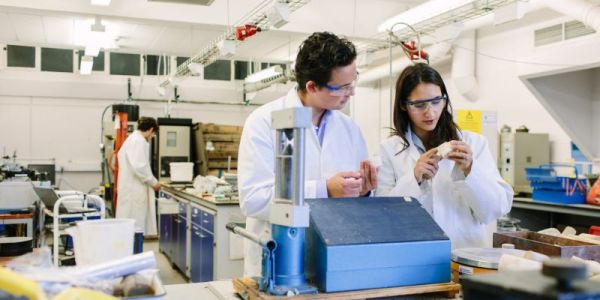
Working in the laboratory.

The courses are designed to provide a concentrated training in geochemistry to prepare appropriate graduates (geologists, chemists or environmental scientists) to work professionally in geochemistry or to start a research degree in geochemistry. They develop knowledge and understanding of theoretical, analytical and applied aspects of geochemistry with an emphasis on quantitative approaches as well as qualitative understanding of geochemical processes. They provide practical training in the acquisition of analytical data in the field and in the laboratory, the interpretation of geochemical data and the generic skills required to communicate geochemical results and arguments on paper and orally. The courses aim to develop a coherent strategy for the use of chemical and/or physical techniques to solve geochemical problems, culminating in an individual research project focused on a specific issue, organised in collaboration with external industrial or government bodies where appropriate.

Benefits of the courses

Geochemical processes, especially at the Earth's surface, play an essential role in sustaining the human environment. Understanding these processes is essential for controlling human influence on the environment, remedying its harmful effects and determining effective responses to environmental change. At the practical level this means, for example, there is a vital role for professional scientists with a good understanding of chemical processes in the natural environment in restoring land contaminated by past industrial activity to a condition fit for new uses.

MSc Geochemistry    
Compulsory modules credits Semester
Laboratory and Field Skills 1 15 1 & 2
Laboratory and Field Skills 2 15 1 & 2
Theoretical Geochemistry 15 1
Metal Transport in Hydrothermal Solutions 15 2
Environmental Geochemistry 15 1 & 2
Groundwater Geochemistry and Contaminant Processes 15 1 & 2
Isotope Geochemistry 15 1 & 2
Communication Skills 15 1 & 2
Dissertation Project 60 3

Programme and Module Descriptions for the MSc Geochemistry are available on the University Taught Postgraduate Catalogue.

MSc Environmental Geochemistry    
Compulsory modules Credits Semester
Laboratory and Field Skills 1 15 1 & 2
Theoretical Geochemistry 15 1
Environmental Geochemistry 15 1 & 2
Groundwater Geochemistry and Contaminant Processes 15 1 & 2
Isotope Geochemistry 15 1 & 2
Communication Skills 15 1 & 2
Dissertation Project 60 3
Plus 30 credits of Optional modules 30 1 & 2

MSc Environmental Geochemistry Optional modules are:
Laboratory and Field Skills 2 (15 credits)
Metal Transport in Hydrothermal Solutions (15 credits)
Geochemistry of Groundwater Pollutants and their Remediation (10 credits)
Air Pollution (10 credits)
Environmental Risk Management (10 credits)
Radioactivity and Humans (10 credits)
Discharge, Sediment and Solute Dynamics in River Management (15 credits)
Environmental Assessment (15 credits)
Law and the Environment (10 credits)

Programme and Module Descriptions for the MSc Environmental Geochemistry are available on the University Taught Postgraduate Catalogue.

Industry links

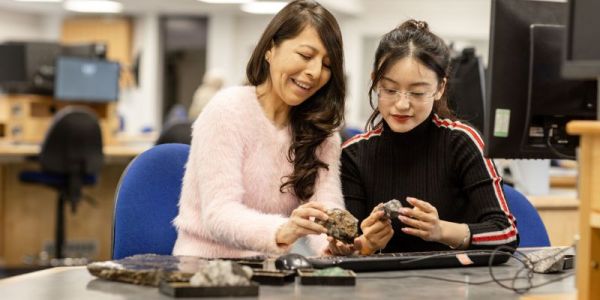
Structures under the microscope.

Professional links are maintained through regular contributions from industry for our programme of seminars and through collaborative student projects with external parties in industry and government agencies.

Career prospects

Graduates typically find employment with environmental and engineering consultancies or government agencies. Several leading consultancies repeatedly recruit graduates from the course. A significant proportion of graduates go on to do further research in the UK or abroad leading to a PhD.

"The specialised nature of the MSc Geochemistry course is what initially attracted me to it; it is one of very few, if not the only course in the U.K. , which is purely geochemistry. The topics covered in the course are directly relevant to my current job as an environmental consultant."

Jack Budworth - an Environmental Consultant with Resource and Environmental Consultants Limited (REC), graduated 2005

"The MSc in Environmental Geochemistry bridged the gap between my undergraduate knowledge and a potential PhD programme. My postgraduate studies gave me the opportunity to combine theoretical knowledge and laboratory experience whilst completing my dissertation and gave me the skills to progress to research."

Nefeli Kafousia - PhD

For more information click here.


Masters Study & Courses