School of Earth and Environment

Improving NWP forecasts by the use of remotely controlled aircraft measurements

Supervisors: Ralph Burton, Barbara Brooks, Alan Gadian and Alan Blyth

Contact: r.r.burton(at)leeds.ac.uk

The lack of measurements of humidity in the atmospheric boundary layer is a major problem for Numerical Weather Prediction (NWP) models, such as the Weather Research Forecasting (WRF) model. The aim of this project is to use an unmanned airborne vehicle (UAV) to measure humidity and other properties of the atmospheric boundary layer in order to compare with high-resolution WRF modelling results.   The ultimate aim is to improve weather forecasts by increasing our knowledge of turbulent processes in the boundary layer.

Observations

Development and verification of NWP models is dependent on measurements of key parameters, particularly the amount of water vapour, but also temperature, pressure wind speed and direction. For example, whether or not a model is able to forecast heavy convective rainfall that may lead to flash flooding is highly dependent on the model being able to correctly simulate the amount of water vapour in the boundary layer (BL). Measurement capability of water vapour is improving, but it is still difficult to get reasonable spatial and temporal coverage, particularly at different heights. Although developments of autonomous sensor networks in recent years have increased the availability of surface measurement and radar refractivity measurements for low-levels, the same is not true for vertical profiles. Vertical profiles are obtained from instrumented masts, radiosondes, instrumented balloons and aircraft. However, cost and availability limits the use of such methods.

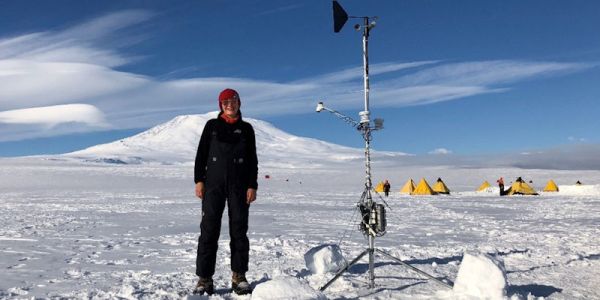
A new method of making measurements in the BL with UAVs and comparing with WRF model results has recently been tried in Iceland.  A great deal of interest is being shown both nationally and internationally in the development of small UAVs based around model airplanes. Such systems offer the capacity for highly spatially resolved measurements (vertically and horizontally) on platforms that are convenient and cheap to deploy. This PhD project will use such a UAV system in conjunction with a number of ground based remote sensors including LIDAR and radiometers, in order to compare with WRF model results.  A series of intensive field deployments will be carried out in Wales and Weybourne and also in Iceland (in conjunction with observations for the VOLCANO consortium), and Antarctica (in collaboration with John King and Phil Anderson, BAS).

The left hand panel shows the UAV that will be used for this project. The right hand panel shows a spiral accent temperature profile taken using the UAV platform.

The left hand panel shows the UAV that will be used for this project which was demonstrated on the Arran 2011 summer school by Nigel King (pictured): Nigel King is also an ongoing collaborator in development of this UAV system for BL measurement and is also responsible for pilot training and adherence to the national and international UAV deployment regulations. The right hand panel shows a spiral accent temperature profile taken using the UAV platform of J. Reuder et al., Meteorologische Zeitschrift, 18, 2009, and is an example of the type of measurement that would be performed. The UAV instrument suite (separate and additional to the avionics package) will provide motion corrected pressure, temperature, humidity, wind speed and direction as well as GPS position and time.  The UAV ceiling is approximately 700m hence ground based remote sensing data is required to provide the deeper profile. Radiosondes, lidar, radiometer, and radar profiles of temperature, humidity, wind speed, and direction will be compared to the UAV in situ measurements before integration in to the WRF model.

Boundary Layer Modelling

WRF (Weather Research and Forecasting) is a state-of-the-art numerical weather prediction computer model developed in the USA and used in over 140 countries. It is user-friendly, easily configurable and can run on desktop computers, in addition to national supercomputers.

WRF can be used both to simulate case studies at high resolution (down to several tens of metres in the horizontal), and to produce long-range and large-area forecasts (e.g. for the north Atlantic and Europe area.) The code uses the latest theoretical developments to represent the boundary layer, microphysics, the land surface, and radiation. WRF has been used extensively at NCAS in Leeds and NCAS is recognized as a centre of WRF expertise in the UK.

Aims of the project

The representation of turbulence in most NWP boundary layer schemes (including those in WRF) is tuned by certain parameters. For example, the vertical mixing of specific humidity caused by large turbulent eddies is often prescribed by a so-called countergradient mixing term. The specification of such terms comes from a combination of theoretical considerations and measurements from observational campaigns.  These measurements have usually been gathered over flat terrain and uniform vegetation. This project will allow the validity of these tuning parameters to be assessed over more complex, inhomogeneous terrain, and thus to potentially improve the boundary layer schemes themselves.

Overview of the use of UAVs for research

The first legal BL flight was performed using this UAV during the NCAS Arran Summer School in 2011 and the interest in the use of this type of micro UAVs for atmospheric measurement is building and to-date UAVs are deployed for aerial surveying in the UK. Both the National Oceanographic Centre (NOC) and BAS have development programs but with an emphasis on surveying rather than atmospheric measurement.  Internationally the push has been the development of the much larger fully autonomous platforms (NASA – GLOBAL HAWKE) with only our collaborators in Iceland having attempted this combination of UAV measurement and WRF. Leeds are spearheading the atmospheric boundary layer drive for small UAV measurement platforms and have already established links with interested parties in UK, European, and USA.

Supervison arrangements

This project will combine the significant observational expertise (Barbara Brooks) and computational modelling expertise (Ralph Burton) both from NCAS within the School. Further, the supervision will be supported by two senior academic staff, Alan Blyth and Alan Gadian.

For further information, see:

http://www.see.leeds.ac.uk/people/r.burton

http://www.see.leeds.ac.uk/people/b.brooks

http://www.see.leeds.ac.uk/people/a.gadian

http://www.see.leeds.ac.uk/people/a.blyth